

Contents
1. Using structural design to achieve strategic goals
- As organizations grow, they add new departments, functions and hierarchical levels. A major problem is how to tie the whole organization together.
- Chain of command work specialization and departmentalization can be not sufficient to coordinate a big organization. Lateral coordination mechanisms provide coordination across departments. They are reengineering.
- Task forces (a temporary team or committee formed to solve a specific short-term problem involving several departments);
- Teams (groups of participants from several departments who meet regularly to solve ongoing problems of common interest);
- Integrating manager (an individual responsible for coordinating the activities of several departments on a full-time basis to achieve specifics).

2. Project or product outcomes
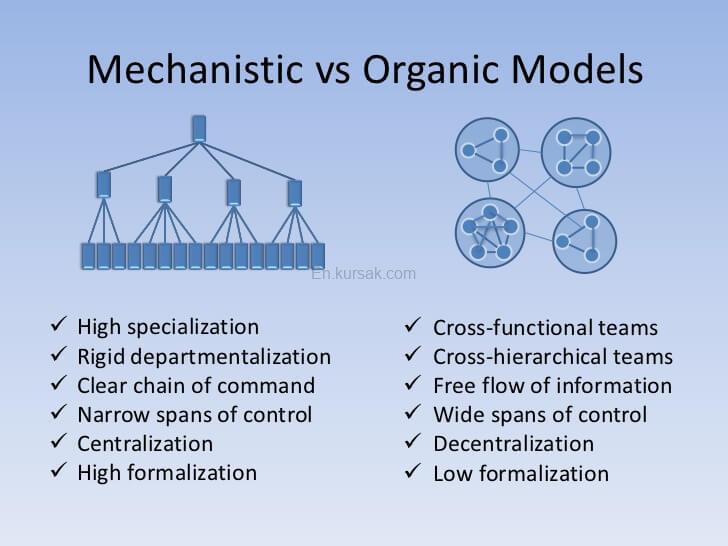
Managers can design organizations to be organic or mechanistic.
Mechanistic organizations rely heavily on vertical structure and are characterized by tight control, whereas
Organic organizations are loosely structured ad rely heavily on lateral coordination mechanisms.
3. Contingency factors of strategy

Environment, size and life cycle, production technology and departmental interdependence influence the correct structural approach.
When a firms strategy is to differentiate the firms product from competitors, a more organic structural approach using teams, decentralization and maybe a divisional or matrix structure is appropriate. When uncertainty is high, lateral coordination is important and the organization should have an organic structure.
Other factors that influence structure are technology, size and interdependence. Mass production is associated or mechanistic structure.
Organizations in the birth and youth stages typically are loosely structural. In the midlife a strong vertical structure emerges. In a mature organization it maybe necessary to arrange teams, task forces etc. to achieve greater cooperation across departments.
When the departmental interdependence is high, horizontal coordination mechanisms (unscheduled meetings, teams, project managers) are required.